On this page
1386: a new cathedral for Milan
Where the Duomo stands today there were two churches: Santa Maria Maggiore, the winter cathedral, and the basilica of Santa Tecla, the summer cathedral. After the bell tower collapsed, on 12 May 1386 Archbishop Antonio da Saluzzo, backed by the people, launched the building of a new, larger cathedral.
The first plan was a brick building in the Lombard Gothic style. But as early as 1387 the lord of Milan, Gian Galeazzo Visconti, took control of the works and imposed a far more ambitious design: a marble cathedral in the late European Gothic style, to stand for the ambitions of his state.
Candoglia marble
Gian Galeazzo made the Candoglia quarries available and granted generous tax exemptions: every block for the site was marked AUF, ad usum fabricae, and travelled free of tolls. Candoglia's white marble veined with pink is still the Duomo's stone, and the quarries still belong to the Veneranda Fabbrica.
A European building site
French and German architects such as Jean Mignot and Heinrich of Gmünd were called in to lead the works, but they stayed only briefly, clashing with the Lombard craftsmen. The result was a building unlike any other in Europe. In 1391 it was decided to go from three to five naves; in 1393 the first pillar capital was carved, to a design by Giovannino de' Grassi.
On 16 October 1418 Pope Martin V consecrated the high altar: from that day the new Duomo began to work as a cathedral, although it was far from finished.
The tiburio and the Renaissance
In 1488 Leonardo da Vinci and Donato Bramante also submitted models for the crossing tower; Leonardo later withdrew his. The tiburio was built by Giovanni Antonio Amadeo with Gian Giacomo Dolcebuono from 1490.
In 1567 Archbishop Charles Borromeo pushed the works forward and put Pellegrino Tibaldi in charge of the Fabbrica; Tibaldi redesigned the presbytery. The church was reconsecrated in 1577, though it was still unfinished. Much of the interior you see today dates from those years: guide to the inside of the Duomo.
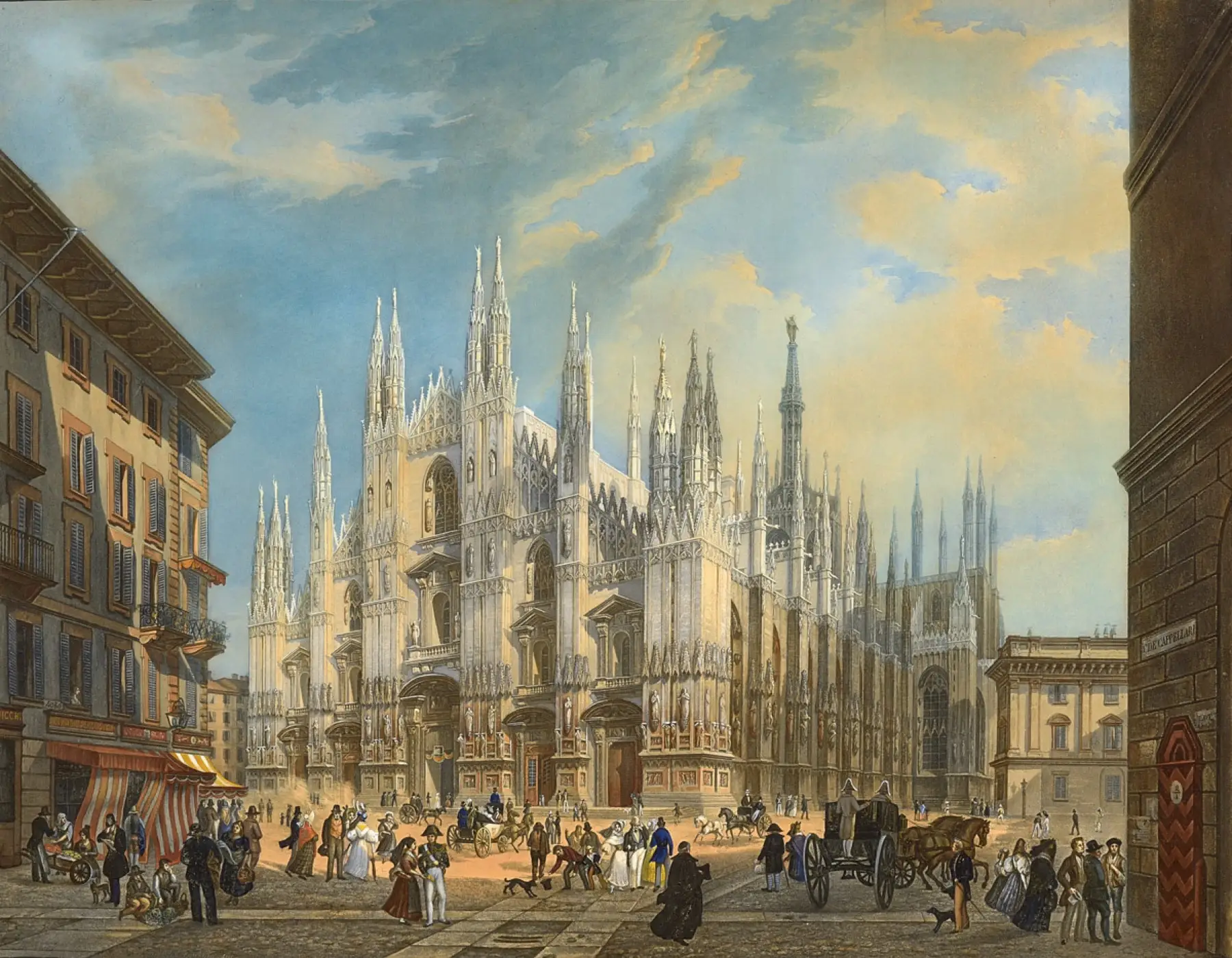
The façade, finished for Napoleon
For two centuries the façade stayed unfinished, through one design after another. Between 1765 and 1769 Francesco Croce completed the main spire, on which the Madonnina was placed five years later.
The breakthrough came with Napoleon: in 1805, ahead of his coronation as King of Italy, held in the Duomo that same year, he had work begun to complete the façade. Carlo Amati finished it in 1813. Statues and spires kept being added throughout the 19th century, until 1892.
War, restoration and the never-ending site
During the Second World War the Madonnina was covered and the stained glass taken down; the bombing still damaged the cathedral, and the central bronze door still bears the marks of shrapnel. After the war the wooden doors were replaced with bronze ones.
In the mid-20th century traffic and a falling water table put the four great pillars holding up the tiburio at risk. In 1969 the area around the Duomo was closed to traffic; the structural restoration of the pillars ran from 1981 to 1986, the 600th anniversary of the founding.
Maintenance never stops: it is the job of the Veneranda Fabbrica del Duomo, born with the building site itself. Hence the Milanese saying "Longh come la fabbrica del Domm", as long as the Duomo works, for something that never ends.
The Duomo in numbers
| Fact | Value |
|---|---|
| Works begin | 12 May 1386 |
| High altar consecrated | 16 October 1418 |
| Reconsecration | 1577 |
| Façade completed | 1813 |
| Height with the Madonnina | 108.5 metres |
| Naves | 5, plus a transept with 3 |
| Pillars | 52 |
| Spires | 135 |
| Marble | Candoglia, quarries owned by the Veneranda Fabbrica |
It is the largest church in Italy (St Peter's is larger, but stands in Vatican City).
Frequently asked questions
When was Milan Cathedral built?
Works began in 1386. The high altar was consecrated in 1418, the façade was completed in 1813 and the last spires and decorations came in the 19th and 20th centuries.
Who built Milan Cathedral?
Archbishop Antonio da Saluzzo began it in 1386; Gian Galeazzo Visconti imposed the marble design. It was built by generations of architects, engineers and stonemasons of the Veneranda Fabbrica, including Giovannino de' Grassi, Giovanni Antonio Amadeo, Pellegrino Tibaldi and Carlo Amati.
How long did it take to build Milan Cathedral?
Almost six centuries: from 1386 to the last works of the 20th century. The façade alone was only completed in 1813.
How tall is Milan Cathedral?
108.5 metres to the top of the Madonnina, on the main spire.
What style is Milan Cathedral?
Gothic: a late Gothic of European inspiration, with capitals and decoration that set it apart from Gothic north of the Alps. The façade combines Gothic and neoclassical elements.