On this page
- The interior in numbers
- The meridian
- Right aisle
- St Bartholomew Flayed
- The Medeghino monument
- Presbytery and Holy Nail
- The organs
- The apse windows
- The oldest doorway
- The Trivulzio candelabrum
- Left aisle
- Crypt and Scurolo of St Charles
- Under the square: the baptistery
- In November: the Quadroni
- Frequently asked questions
Official ticket office prices, checked on 25 October 2026. The cathedral and Museum visit takes at least 60 minutes.
The interior in numbers
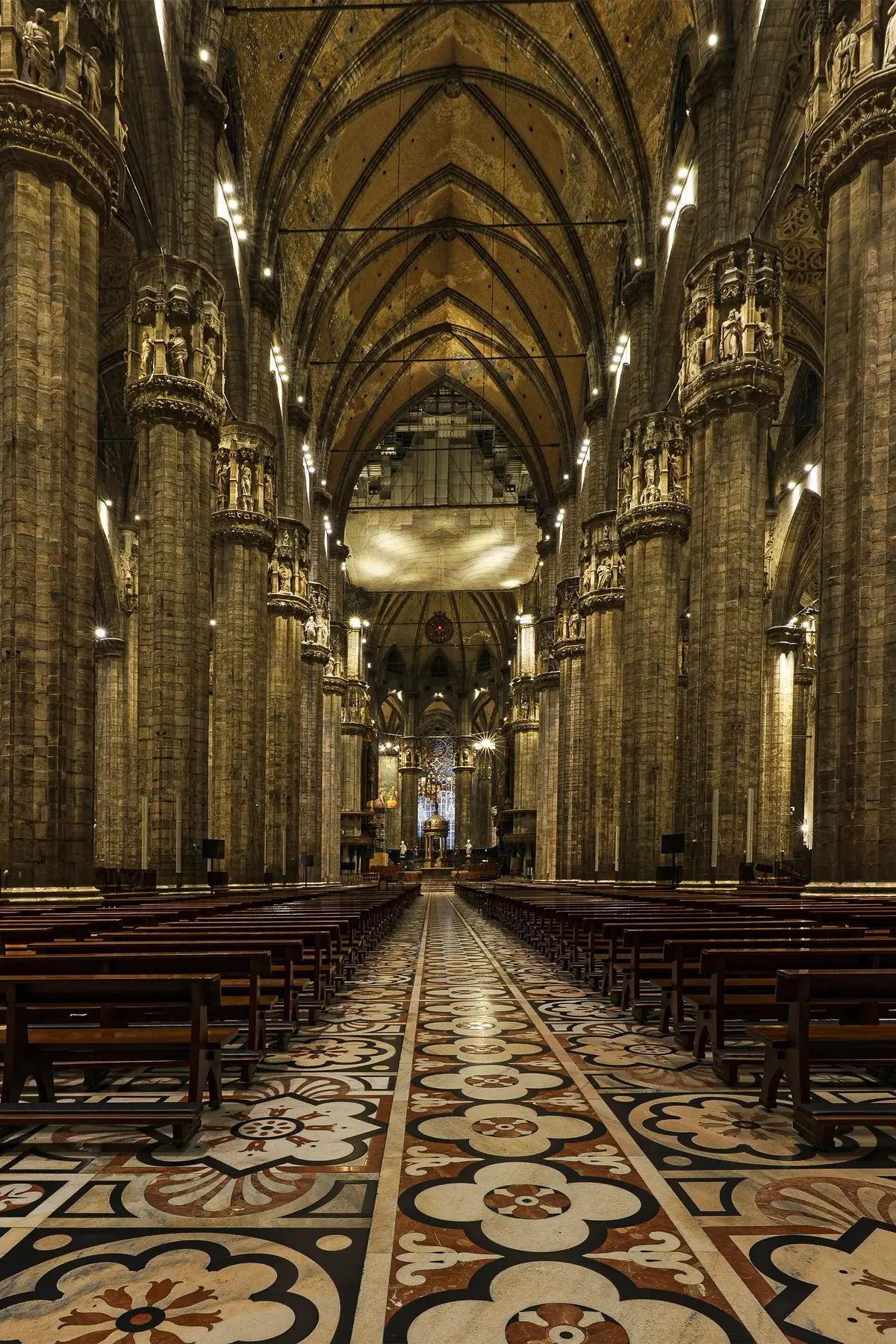
Walk in from the façade and you face a forest of stone. The church has five naves and a transept with three; the central nave is twice as wide as the side ones and about 45 metres high: the tallest Gothic vaults of any completed church. They rest on 52 clustered pillars with capitals full of niches and statues of saints and prophets.
In the middle, above the crossing, rises Giovanni Antonio Amadeo's tiburio, 68 metres high. The vaults look carved like lace, but it is an illusion: the tracery is painted, begun in the 1400s and finished in the 1800s.
The meridian, just inside the entrance
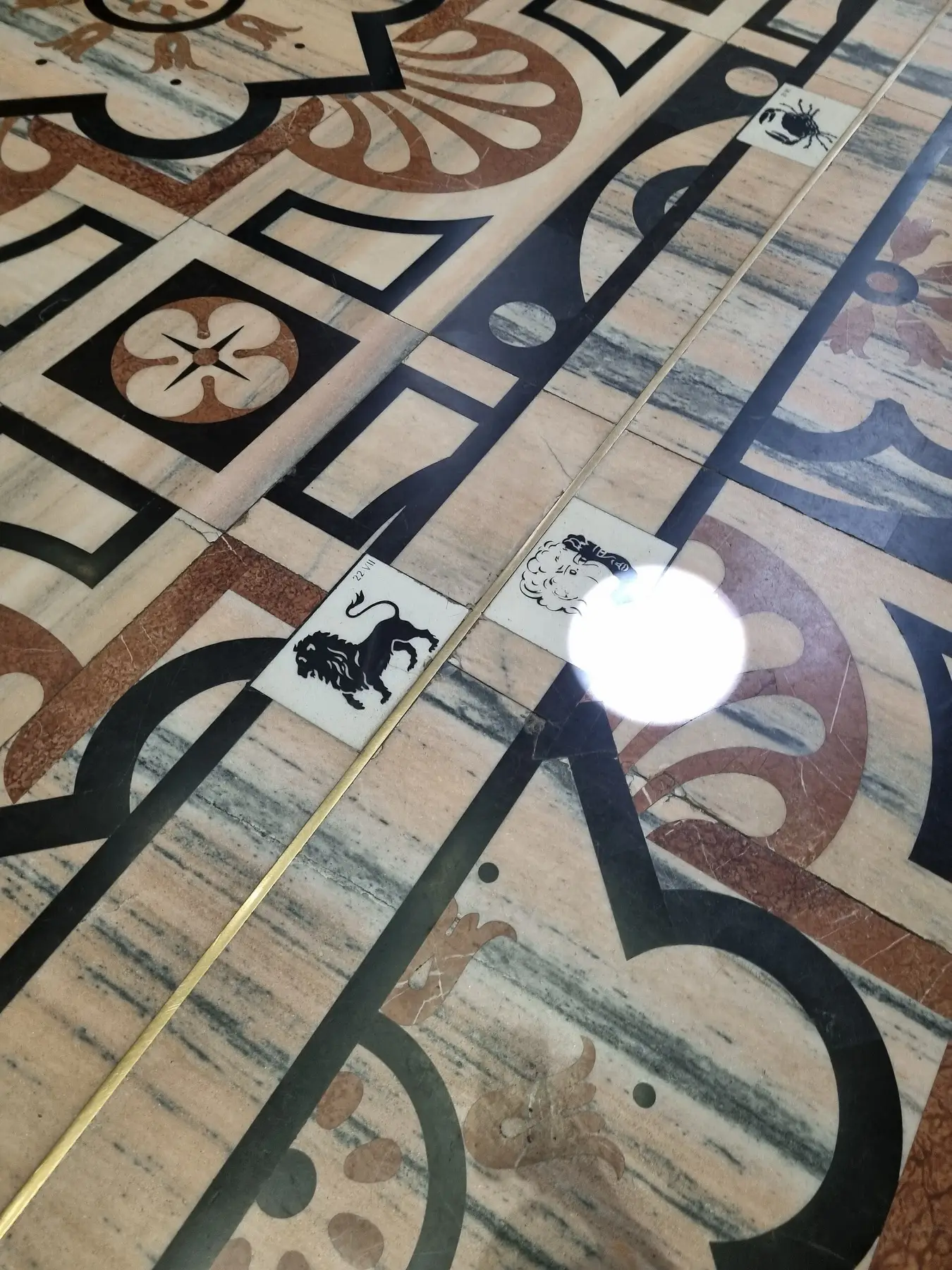
As soon as you are in, look at the floor: a brass strip crosses the nave and climbs three metres up the north wall. This is the meridian built in 1786 by the astronomers of Brera. On the opposite wall, almost 24 metres up, there is a small hole: at solar noon the beam of light falls on the line, next to marble plaques with the signs of the zodiac.
The meridian once set Milan's clocks: when the beam touched the line, a signal went to the tower of the Palazzo dei Giureconsulti and from there to the Sforza Castle, where a cannon shot announced noon.
Right aisle: archbishops and patrons
Along the right aisle are some of the oldest tombs in the cathedral.
- The rough stone sarcophagus of Archbishop Aribert of Intimiano (died 1045), topped by a copy of his gilded copper crucifix; the original is in the Duomo Museum.
- The tomb of Ottone Visconti, the archbishop with whom the Visconti lordship began, brought from the old basilica of Santa Tecla.
- The sarcophagus of Marco Carelli, the patron who gave thirty-five thousand ducats to speed up the works: a masterpiece of late Gothic sculpture (1406).
- The window with the Stories of St Eligius, made by Niccolò da Varallo between 1480 and 1489: one of the few Renaissance windows that survive whole, with scenes of 15th-century daily life.
St Bartholomew Flayed
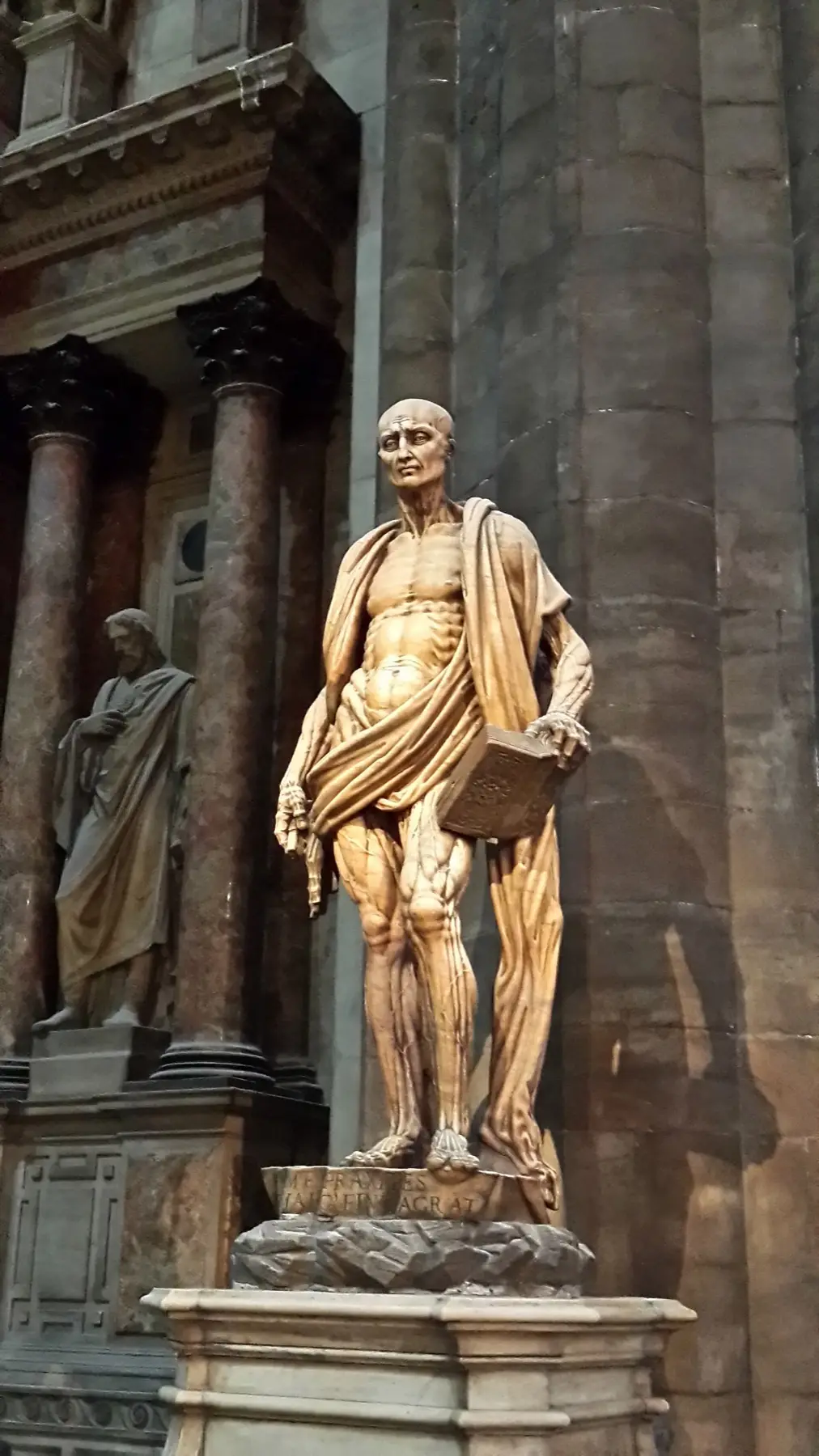
In the right transept stands perhaps the most famous statue in the Duomo. The apostle Bartholomew, martyred by being flayed alive, is shown with his muscles exposed and his own skin thrown over his shoulders like a stole. It is the work of Marco d'Agrate (1562), who proudly signed the base: "Non me Praxiteles sed Marcus finxit Agrates", not Praxiteles but Marco d'Agrate made me.
More than a devotional image, it is an anatomy lesson carved in marble.
The Medeghino monument
Opposite St Bartholomew is the funerary monument to Gian Giacomo Medici, known as il Medeghino, made by Leone Leoni between 1560 and 1563 for his brother, Pope Pius IV. The condottiero is in bronze, his cloak covering his lame leg; at the sides stand Peace and Military Virtue. Next to it, the altar in precious stones (chalcedony, serpentine, lapis lazuli) designed by Pirro Ligorio and given by the pope to his nephew, Charles Borromeo.
Presbytery and Holy Nail
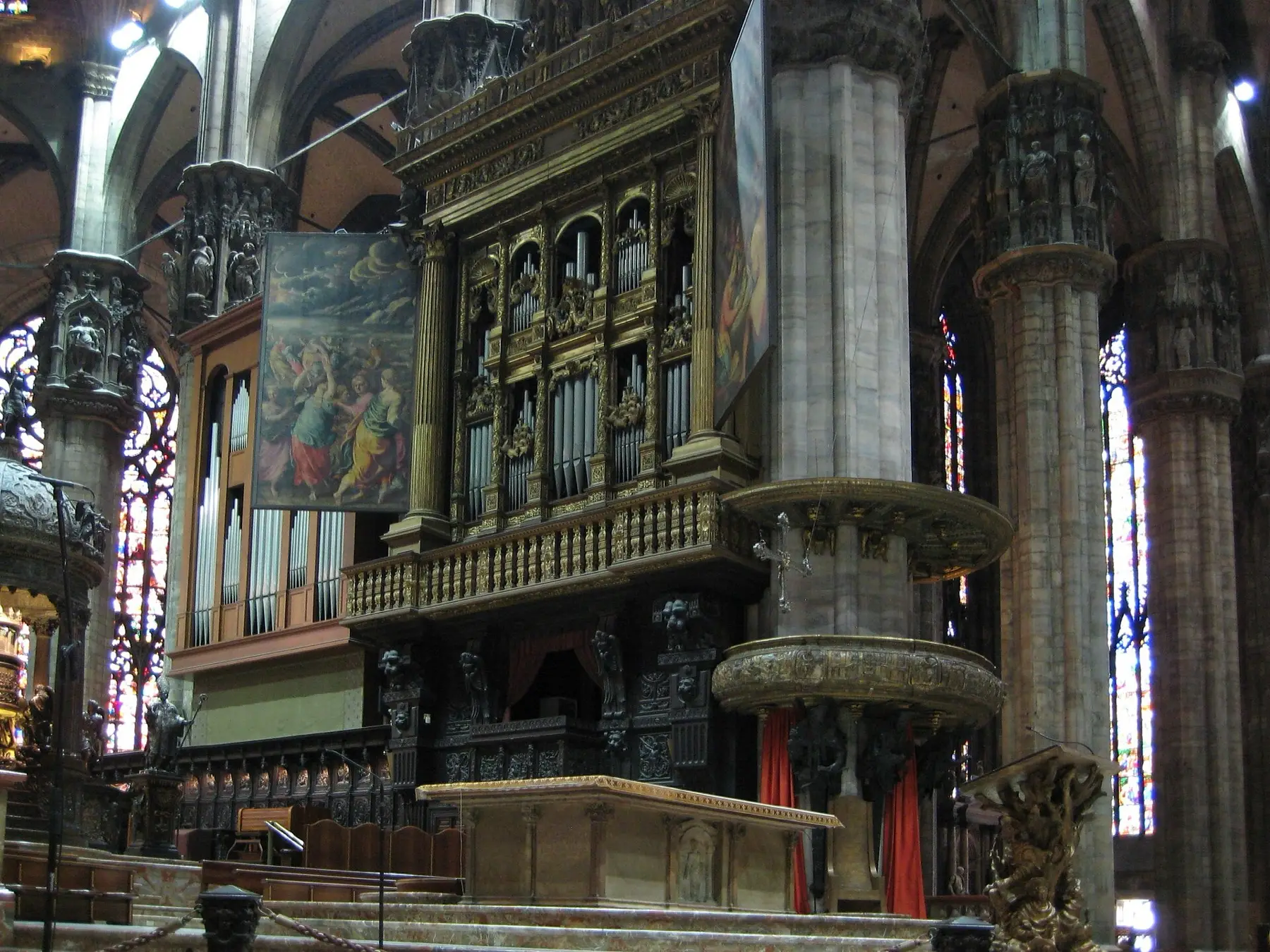
The heart of the cathedral is the presbytery commissioned by St Charles Borromeo and designed by Pellegrino Tibaldi. The high altar was consecrated by Pope Martin V on 16 October 1418, the day the new Duomo began working as a church. In the middle stands the round shrine holding the tabernacle, a gift of Pius IV to his nephew; at the sides, the great silver statues of St Charles (1610) and St Ambrose (1698).
Look up at the vault above the altar: a small red light marks the most precious relic of the Duomo, the Holy Nail, by tradition one of the nails of the Cross. To take it down the archbishop rides the nivola, a 17th-century cloud-shaped lift, which gives its name to the Rite of the Nivola, held in September for the feast of the Exaltation of the Holy Cross.
The organs
The two great gilded cases at the sides of the presbytery belong to the 16th-century organs by Gian Giacomo Antegnati and Cristoforo Valvassori, now part of a single instrument with 15,800 pipes, one of the largest in the world. Among the Duomo's organists was Johann Christian Bach, son of Johann Sebastian.
The apse windows
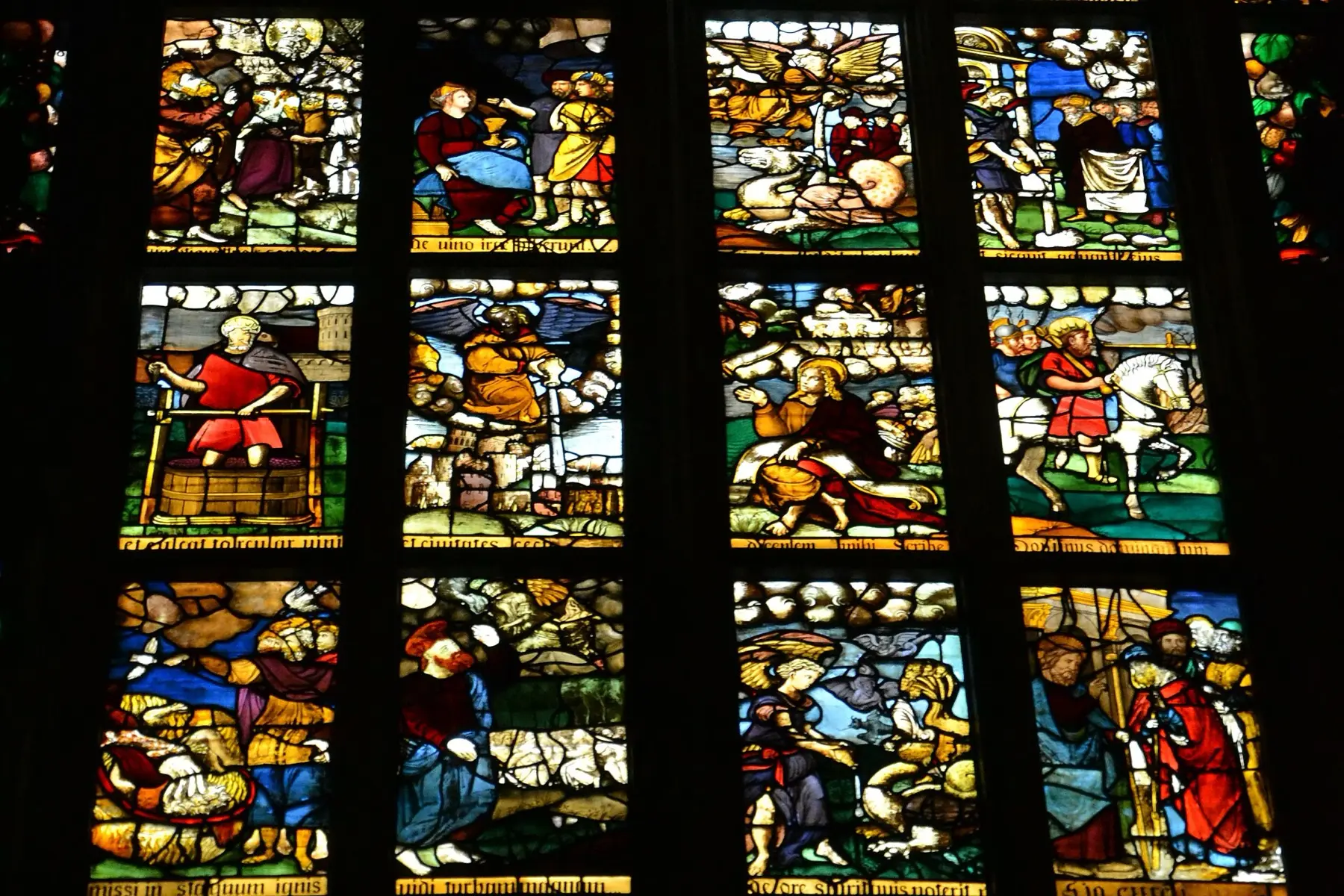
Walking behind the altar, in the ambulatory, you reach the three great apse windows, the oldest and largest in the cathedral. The two side windows, with 130 panels each, tell the Old and New Testament and were remade by the Bertini family between 1833 and 1865. The central one, devoted to the Apocalypse, keeps some fifty pieces from the 15th and 16th centuries at the top: it was commissioned in 1416 and is called "della razza" after the great radiant sun, emblem of the Visconti.
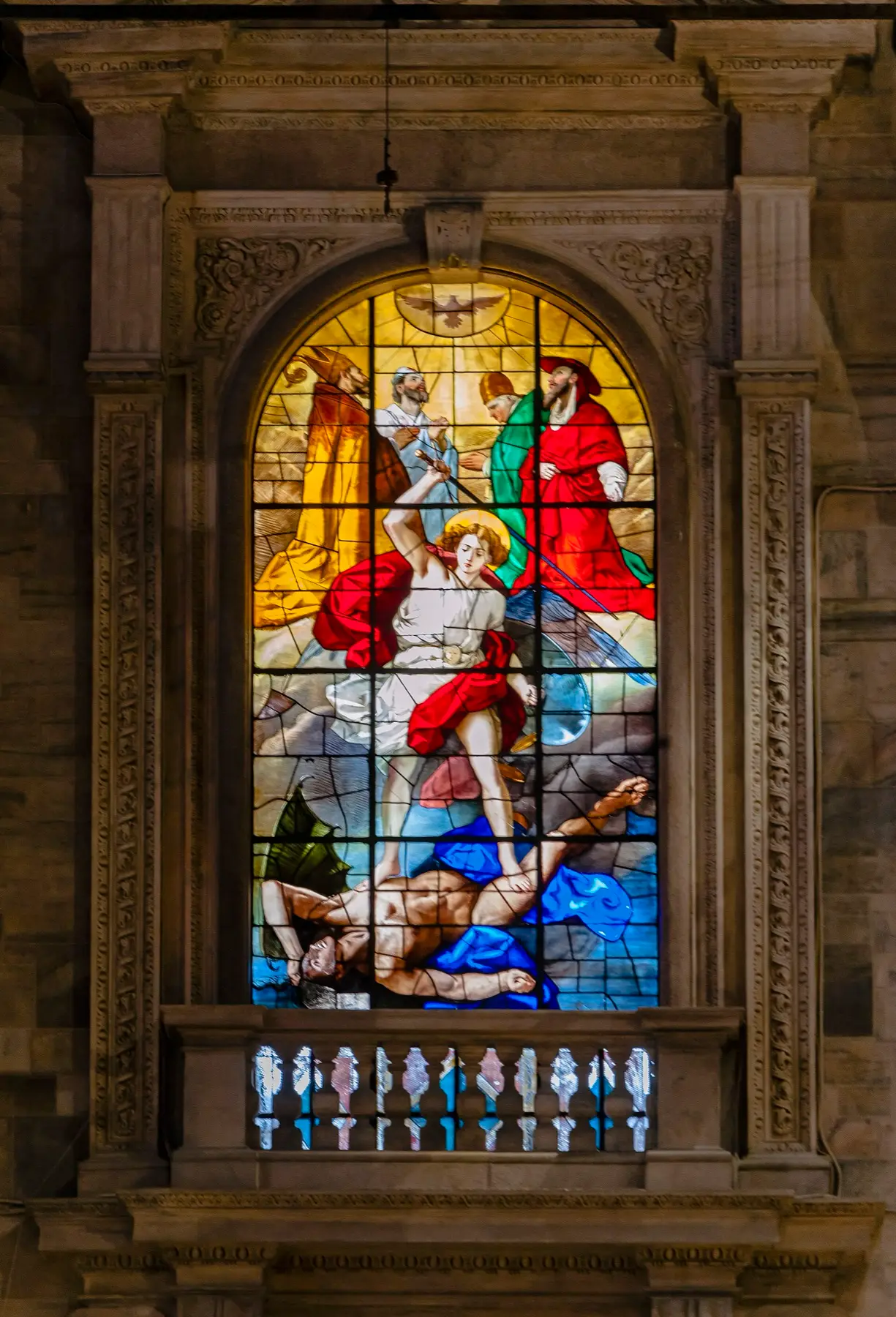
Along the aisles the style of the windows changes every few metres: Renaissance, Mannerist, 19th and 20th century. The one with St Michael casting down the devil (Giovanni Domenico Buffa, 1939), in the left aisle, is the only one that tells a single scene over its full 17 metres.
The oldest doorway
In the ambulatory, the doorway of the north sacristy marks the exact spot where construction began. Its carving, by Giacomo da Campione and Giovannino de' Grassi, dates from 1386: it is the oldest sculpture in the Duomo, with heads of prophets with flowing beards and fanciful headgear, and traces of the original colours.
The Trivulzio candelabrum
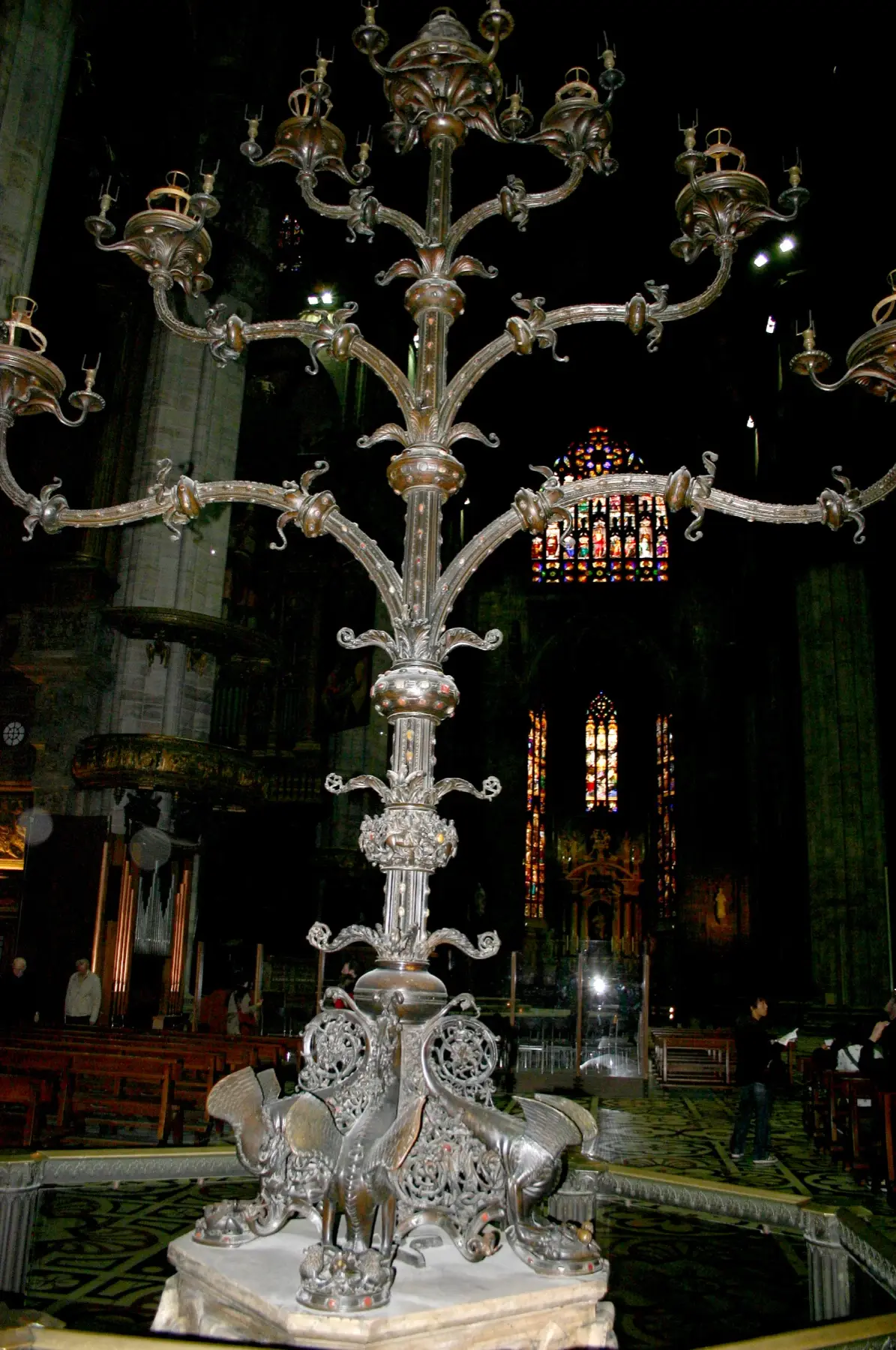
In the left transept, in front of the chapel of the Madonna dell'Albero, rises a gigantic bronze tree: the Trivulzio candelabrum, donated in 1562 by the archpriest Trivulzio. It is a medieval masterpiece attributed to Nicholas of Verdun or to Rhenish artists: its foot rests on fantastic beasts, and along the branches run scenes from the Old Testament, the Liberal Arts, the Rivers and the Adoration of the Magi.
In the same transept a small door opens onto the Princes' Staircase, once reserved for distinguished guests: today it leads to the lift for the rooftop terraces.
Left aisle
- Pellegrino Tibaldi's baptistery: a small temple on four columns whose basin is a Roman porphyry sarcophagus.
- The altar of the Crucifix of St Charles, with the wooden crucifix the saint carried in procession during the plague of 1576. Cardinal Carlo Maria Martini is buried beneath the altar.
- The window of the Four Crowned Saints, designed by Tibaldi in 1567: the four martyred sculptors, patrons of stonemasons.
- The altar of St Ambrose with Federico Barocci's altarpiece (1603): Emperor Theodosius kneeling before the bishop of Milan.
Crypt and Scurolo of St Charles
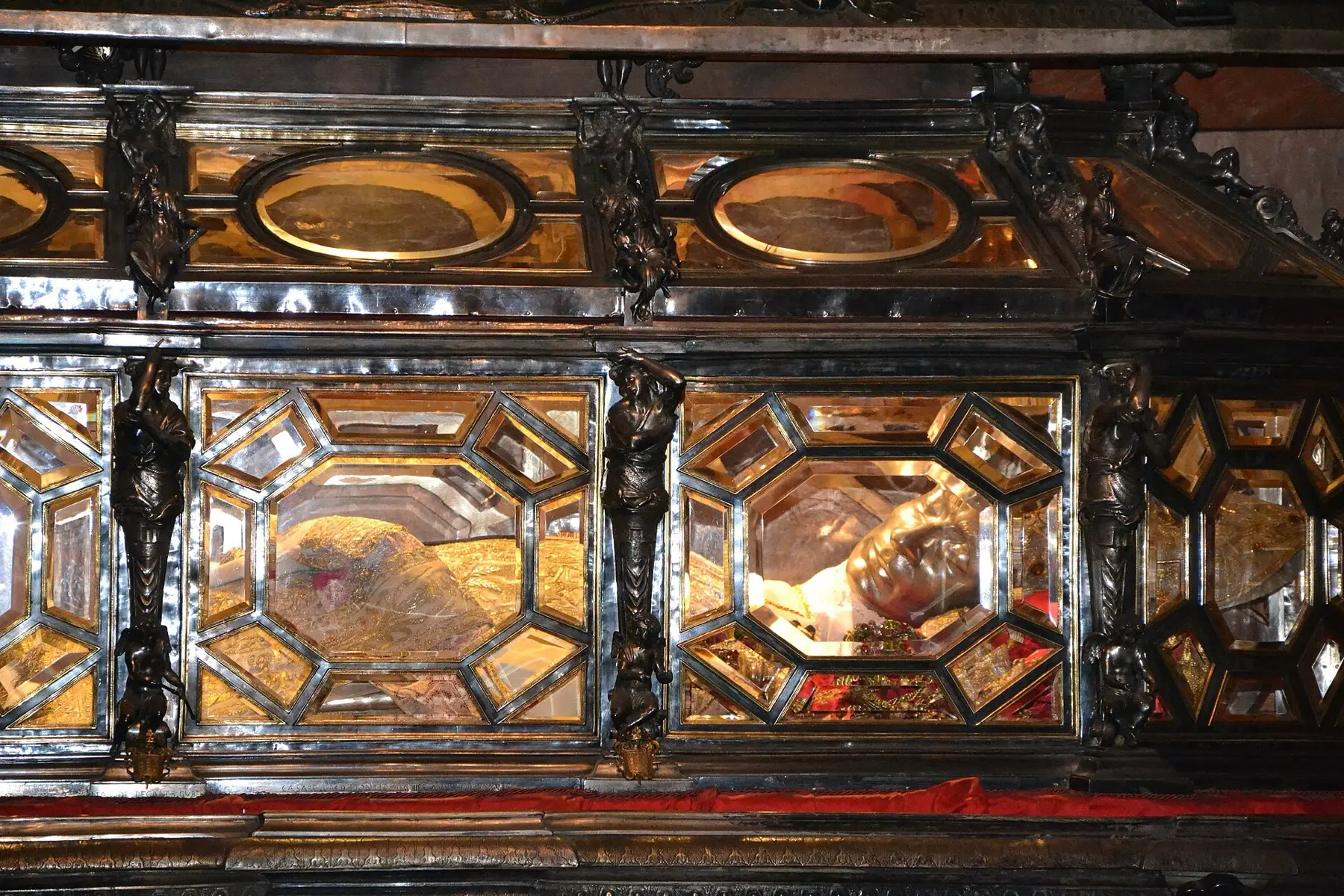
From behind the choir a staircase goes down below the presbytery. Tibaldi's round crypt was the canons' "winter choir", warmer than the church. Opposite is the Scurolo of St Charles, Francesco Maria Richini's octagonal chapel (1606) lined with silver panels telling the saint's life. In the middle, the silver urn with rock-crystal sides, a gift of Philip IV of Spain, holds the body of Charles Borromeo in pontifical robes.
Entry with a €3.50 add-on or with the Culture Pass (€15).
Under the square: St Ambrose's baptistery
A staircase near the entrance leads about four metres below the square, to the floor level of 4th-century Milan. Here are the remains of the baptistery of San Giovanni alle Fonti, built between 378 and 397: octagonal, over 19 metres across, with the baptismal font in the middle. It is where St Ambrose baptised St Augustine on Easter night in 387. Next to it you can see the apses of the basilica of Santa Tecla, demolished in 1461–1462.
The Archaeological Area needs a €5 add-on or the Culture Pass (€15), which also covers the crypt and the Museum.
In November: the Quadroni of St Charles
Every year in November, the month of the feast of St Charles (4 November), the Duomo displays the Quadroni: a cycle of large 17th-century canvases on the life and miracles of the saint, painted by the leading Lombard painters of the time, including Cerano and Giulio Cesare Procaccini. The canvases of the larger series measure six metres by four and three quarters. It is the time of year when the inside of the Duomo changes most.
Before you go in
- There are security checks at the entrances: empty your pockets of metal objects and open your bags.
- Suitcases, helmets and glass objects are not allowed in the cathedral; large bags are discouraged.
- Shoulders and knees covered; no hats, backpacks, food and drink, tripods or flash. No high heels or prams on the terraces.
For hours, Museum closing days and services, see the Duomo opening hours; for concessions and passes, all ticket prices.
Frequently asked questions
Do you have to pay to see inside Milan Cathedral?
For a visit, yes: the Duomo + Museum ticket costs €10 (reduced €5); on Wednesdays there is the Duomo-only ticket at €8. Entry is free only to pray or attend Mass, through the worshippers' entrances.
What should I see inside the Duomo if I'm short on time?
The meridian by the entrance, St Bartholomew Flayed in the right transept, the red light of the Holy Nail above the altar, the three apse windows and the Trivulzio candelabrum in the left transept. At a relaxed pace, a good half hour.
Are the crypt and the Scurolo of St Charles included in the ticket?
No, they are an add-on at €3.50. They are included in the Culture Pass (€15), which also covers the Archaeological Area and the Museum.
Can you take photos inside the Duomo?
The access rules of the official ticket office ban flash, tripods and drones.
When are the Quadroni of St Charles on display?
Every year in November, the month of St Charles Borromeo (feast day 4 November). The large 17th-century canvases are shown in the cathedral throughout the month.
Sources
- Official ticket office: Duomo + Museum, prices, hours and add-ons — checked on 25 October 2026
- Duomo Museum: concessions (Wednesday Duomo-only ticket) — checked on 25 October 2026
- Wikipedia (it): Duomo di Milano, architecture and interior decoration
- Wikipedia: Milan Cathedral, vault height and meridian