On this page
Who made her and when
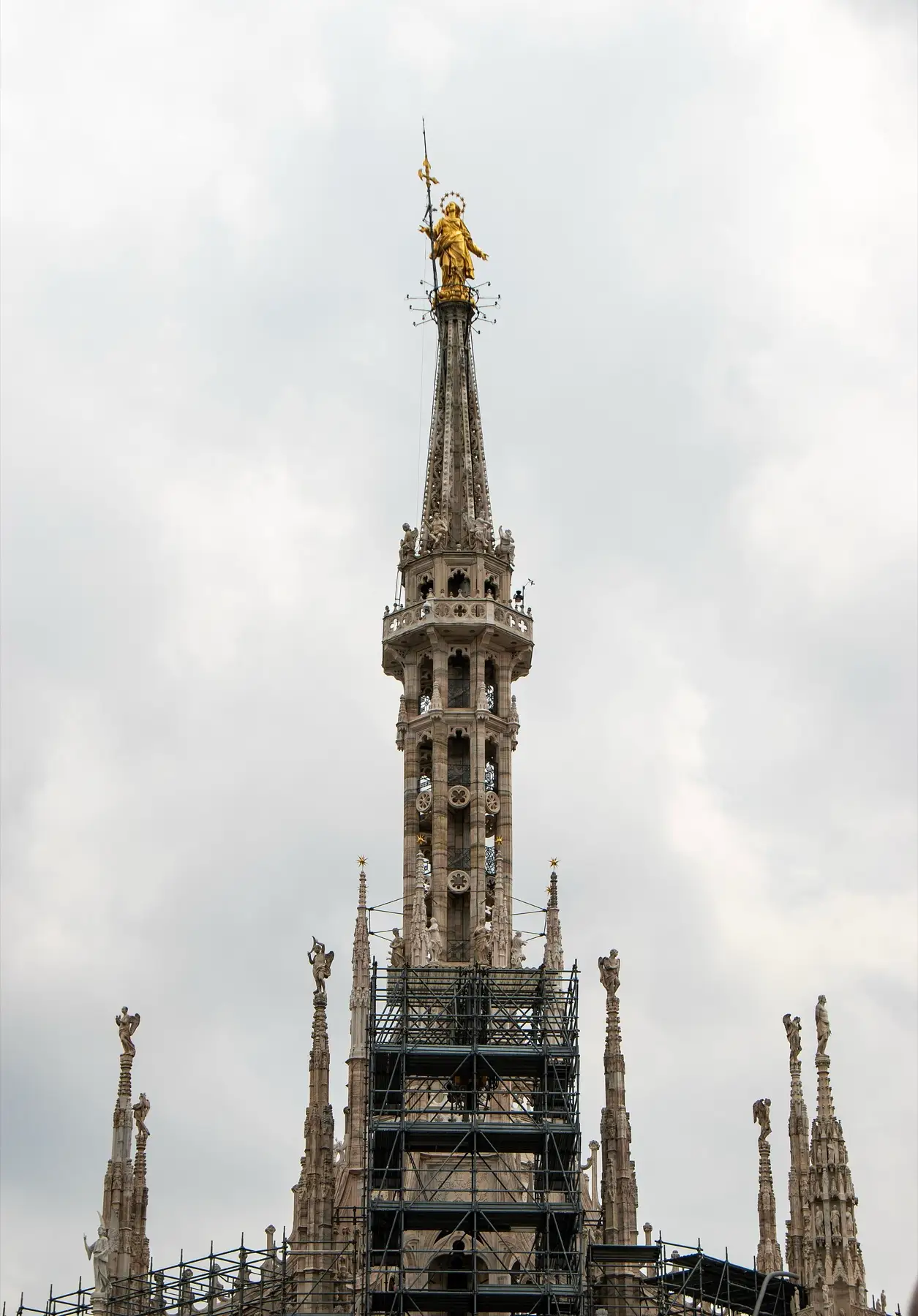
In the 18th century the Duomo still had almost no spires. On 16 July 1765 the chapter of the Veneranda Fabbrica decided to raise the main spire above the tiburio: it was designed and built by the Fabbrica's architect Francesco Croce, who finished it in 1769.
For the statue on top a competition was held among the Fabbrica's sculptors. Giuseppe Perego, a pupil of Elia Vincenzo Buzzi, won with the simplest of his models: the Virgin of the Assumption on a cloud, with no angels around her, her gaze and arms open towards the city. A walnut copy was made from the model and translated into sheets of embossed, gilded copper by the goldsmith Giuseppe Bini.
On 30 December 1774 the statue was hoisted and fixed to the spire. Perego's terracotta models are kept in the Duomo Museum.
How tall is the Madonnina
The statue is 4.16 metres tall; with the main spire the Duomo reaches 108.5 metres. It is the highest point of the cathedral. The halberd the Madonnina holds is in fact a disguised lightning rod.
By tradition no building in Milan was to stand taller. A law made official in the 1930s kept the Torre Branca and the Torre Velasca below 108.5 metres. Behind the respect there were also technical reasons: the water table under the city made taller, heavier buildings risky.
The copies on the skyscrapers
When skyscrapers rose above the Duomo, Milan found a compromise: a copy of the Madonnina on top.
- On the Pirelli Tower, seat of the regional council, 127 metres high.
- On Palazzo Lombardia, seat of the regional government, since 2010, at 161 metres.
- On the Isozaki Tower, since 22 November 2015, at 209.2 metres: the highest copy, made in Nola, near Naples.
War and restorations
During the Second World War the statue was covered with cloths so that the glint of the gold would not become a landmark for bombers.
In 1967 she was taken apart sheet by sheet and regilded; the corroded iron frame inside was replaced with stainless steel and the original went to the Duomo Museum. Another regilding came in 2012, together with the restoration of the main spire.
The symbol of Milan
For the Milanese, "in the shadow of the Madonnina" simply means "in Milan". In 1935 Giovanni D'Anzi dedicated the dialect song "O mia bela Madunina" to her.
There is also a weather saying: when the Madonnina can be seen from afar, the weather is fine. In fog, common in winter, the statue disappears.
How to see her up close
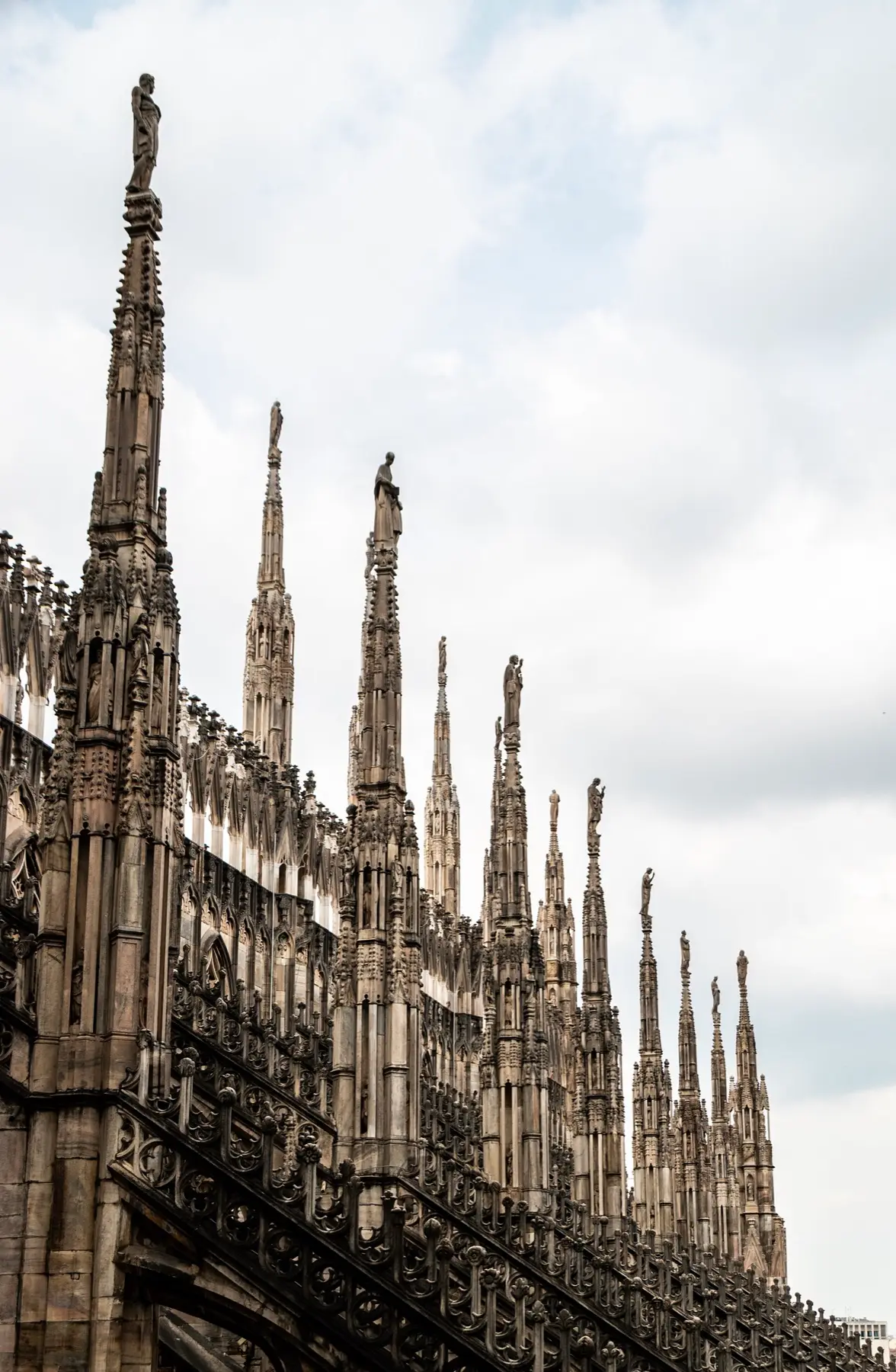
From the square the Madonnina is a golden dot more than a hundred metres up. The way to get closer is to go up to the rooftop terraces: 251 steps on foot or the lift to the first level. Up there the main spire rises in the middle of the roof. All about the Duomo rooftop.
The rooftop costs €16 by stairs and €18 by lift; with the cathedral €22. All prices on the tickets page.
Frequently asked questions
How tall is the Madonnina of Milan Cathedral?
The statue is 4.16 metres tall and stands on top of the main spire, 108.5 metres above the ground.
Who made the Madonnina?
She was designed by the sculptor Giuseppe Perego and made in embossed, gilded copper sheets by the goldsmith Giuseppe Bini. She was set in place on 30 December 1774.
Is the Madonnina made of gold?
No, she is gilded copper. She was regilded in 1967 and in 2012.
Why is there a Madonnina on Milan's skyscrapers?
By tradition no building was to stand taller than the Madonnina. Copies of her were placed on the skyscrapers taller than the Duomo: the Pirelli Tower, Palazzo Lombardia and the Isozaki Tower.
Can you climb up to the Madonnina?
Not to the statue itself, but from the Duomo rooftop you see her up close, on top of the main spire.
Sources
- Wikipedia (it): Madonnina
- Wikipedia (it): Duomo di Milano
- Official ticket office: Terraces — checked on 25 October 2026